
Many small businesses are losing sales without realizing their website is the cause. The phone rings less than it should, booking calendars have gaps and online orders stall, while the site looks "fine." The right web development services for small business fix the specific problems that stop visitors from becoming customers. This guide explains which services matter most, what each one does and how to prioritize them on a budget, based on our work with small businesses at Savoir Management.
Why is your website quietly losing sales?
Most websites lose sales through small frictions: unclear messages, slow mobile pages, hard-to-find calls to action, long forms, missing trust signals and poor visibility in search. Each one removes a share of potential customers before they contact you.
Visitors decide quickly. Nielsen Norman Group found that users often leave pages within 10 to 20 seconds unless the page makes its value clear. Most of those visitors are on phones: Pew Research Center reports 91% of U.S. adults own a smartphone. A website built without these realities in mind leaks sales every day.
Which core web development services directly impact sales?
Conversion-focused strategy and design, mobile-responsive development, speed optimization, SEO, booking or e-commerce, integrations, accessibility, security and analytics. Together they turn traffic into revenue.
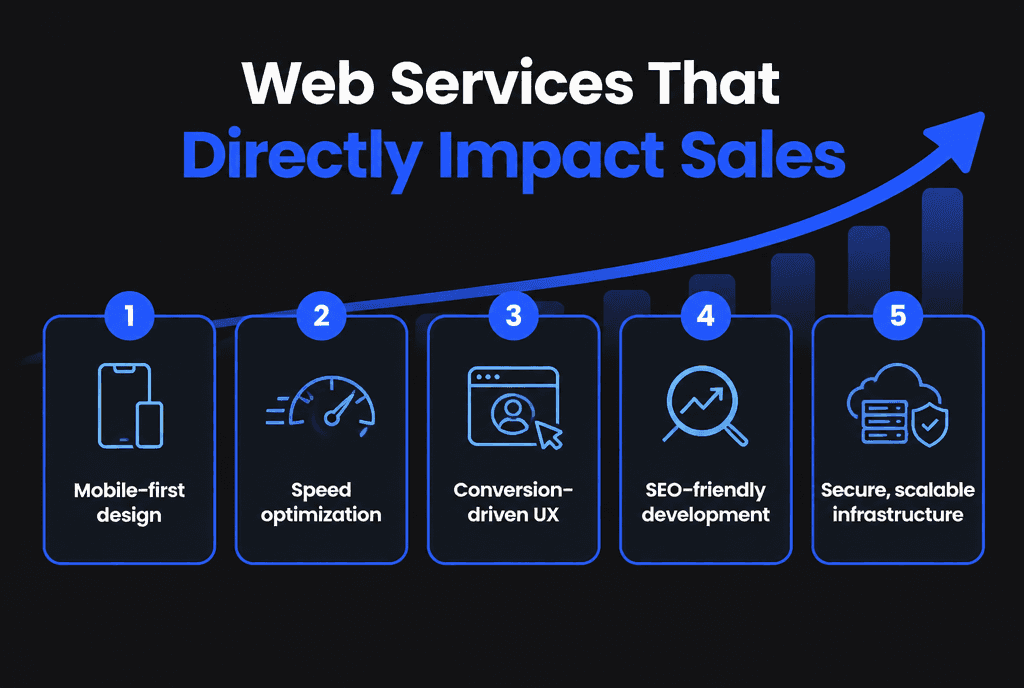
The sections below explain what each service does and how it affects sales.
Service 1: Why does conversion-focused strategy and design come first?
Strategy decides what the site says, who it speaks to and what action each page asks for. Without it, even a beautiful site produces few leads.
A strategy phase defines your best customers, the questions they ask before buying and the one action you want from each page. Design then makes that path obvious: a clear headline, benefits, proof near calls to action and simple next steps. Strategy also produces a sitemap: a planned list of pages built around how customers search and decide, such as one page per service, pages for the areas you serve, an about page that builds trust and a contact or booking page with no friction. That plan prevents the most common small business problem, a single generic "Services" page trying to rank and convert for everything at once. Read our guide to conversion-focused web development.
Service 2: What does mobile-responsive development deliver?
A responsive build makes every page, form and checkout easy to use on phones, where most local searches and many purchases now happen.
Responsive development covers fluid layouts, readable text, large tap targets, tappable phone numbers and forms designed for thumbs. Google also uses the mobile version of your site for indexing, as explained in its mobile-first indexing best practices. See our mobile-responsive development guide.
Service 3: How does speed optimization increase sales?
Faster pages keep more visitors on the site, help ads perform better and support search visibility. Speed work targets images, scripts, fonts and hosting.
Aim for LCP within 2.5 seconds, INP of 200 milliseconds or less and CLS of 0.1 or less, as described on web.dev. Our site speed guide explains which fixes make the biggest difference.
Service 4: What does SEO-focused development include?
Technical SEO and site structure: a page for each service and location, unique titles and headings, structured data, clean URLs, internal links and a sitemap. These help customers find you without paying for every click.
Google ranks local results on relevance, distance and prominence, according to its local ranking tips, and its SEO Starter Guide covers the fundamentals. Read our guides to SEO-optimized web development and local SEO web development.
Service 5: When do you need booking or e-commerce development?
If customers buy appointments or products, letting them book or buy online removes friction and captures sales outside business hours. Short, mobile-friendly flows matter most.
Baymard Institute puts the average documented cart abandonment rate at 70.22%, which shows how much revenue depends on smooth checkout and booking flows. Read booking system website development and e-commerce upgrades that increase sales.
Service 6: Why do integrations matter for small businesses?
Integrations connect the website to your CRM, email marketing, calendar, payments and inventory, so leads are followed up instantly and orders flow without manual work.
Fast follow-up wins business. When a form submission lands directly in your CRM and triggers a confirmation email, nothing falls through the cracks. Automations such as review requests after a job or abandoned cart reminders recover sales you would otherwise lose.
Common integrations for small businesses include:
CRM: every lead captured with its source, so you can follow up and see which channels work
Email marketing: newsletter sign-ups, welcome sequences and promotions
Calendar and booking: real-time availability, confirmations and reminders
Payments: deposits, invoices or online checkout
Reviews: automatic review requests after a completed job or delivery
Inventory or point of sale: stock levels that stay accurate between your shop and website
Service 7: Why are accessibility, security and maintenance part of sales?
Accessible sites serve every customer and reduce legal risk; secure, maintained sites stay online, fast and trustworthy. Problems in any of these areas cost sales directly.
Build to WCAG; the DOJ's web accessibility guidance explains how the ADA applies to businesses open to the public
Protect forms and logins against the OWASP Top 10
Keep software updated, back up regularly and monitor uptime
Service 8: How do analytics and conversion optimization grow sales over time?
Analytics show which pages, channels and campaigns produce customers; conversion optimization uses that data to improve weak pages. Small, steady improvements compound.
Set up conversion events using Google Analytics recommended events for calls, forms, bookings and purchases. Review monthly and improve the pages with the most traffic and the fewest conversions first.
What are the hidden costs of skipping these services?
Skipping core services shows up as fewer leads, wasted ad spend, missed search traffic, lost bookings, emergency repairs and eventually a premature rebuild.

No strategy: visitors do not understand why to choose you
No mobile optimization: phone visitors leave before calling
No speed work: ads pay for clicks that bounce
No SEO: competitors take the searches you should win
No tracking: you cannot tell what works, so budgets are guesses
No maintenance: a broken plugin or hack takes the site offline
Which signs show your website needs these services?
Traffic without inquiries, a site that feels slow or awkward on phones, few appearances in local search, frequent "I couldn't find" comments from customers, manual follow-up of every lead and no idea which marketing works.
Run a quick self-check:
Can a new visitor tell what you do and where you work within a few seconds?
Can they call, book or buy in two or three taps on a phone?
Does each core service have its own page with a clear call to action?
Do reviews and credentials appear near those calls to action?
Do form submissions reach the right person instantly?
Can you see how many leads the website produced last month, and from where?
Every "no" points to one of the services above. Fixing the earliest problem in the customer journey usually has the biggest effect.
What results should you expect, and when?
Conversion fixes such as clearer messaging, faster mobile pages and easier booking often show results within weeks. SEO improvements build over months. Tracking shows progress from the first day.
Set a baseline before any work starts: monthly visitors, calls, form submissions, bookings or orders, and conversion rate. Then compare the same period after launch. Expect quick wins where friction was obvious, such as a broken mobile form or a hidden phone number, and steadier growth from search visibility and content. If a change does not move the numbers, the data tells you where to look next.
How should a small business prioritize services on a budget?
Start with the bottleneck. If few people visit, invest in SEO and campaigns. If visitors come but do not convert, invest in strategy, mobile design, speed and booking or checkout. Always include tracking.
A practical order for most small businesses:
Strategy, messaging and conversion-focused design
Mobile-responsive build with speed optimization
SEO foundations, service and location pages
Analytics and conversion tracking
Booking, e-commerce or integrations as needed
Ongoing maintenance and conversion optimization
How do you choose a provider for these services?
Choose a provider who asks about your goals first, shows results for similar businesses, explains what is included in writing and offers support after launch.
Our guides to choosing the right web development company and hiring a local web developer list questions to ask and red flags to avoid.
What is the competitive advantage of partnering with Savoir Management?
We combine strategy, design, development, SEO and analytics in one team, prioritize the services that move your sales first and keep improving the site after launch.

Our web development team works with small businesses on WordPress, Shopify and custom builds. Read also our web development strategy for service-based businesses and affordable custom web development.


