
Knowing how to choose a web development company protects more than your budget. The wrong partner can leave you with a site that does not perform, a domain you do not control, or a half-finished project and a developer who stopped answering emails. The right partner becomes a long-term asset. This guide walks through the steps we recommend to every business owner, including the red flags we see when clients come to Savoir Management after a bad experience elsewhere.
Why is choosing the right company so important?
Your website affects how customers find you, how they judge you and whether they contact you. A poor choice costs the build price plus months of lost leads, and often a second project to fix or replace the first.
Problems from a bad hire usually appear after the contract is signed: missed deadlines, endless change fees, slow or broken pages, no search visibility, or a site you cannot update or move. Most of those problems can be spotted in advance if you know what to look for.
Step 1: How do you define what you actually need?
Write a short brief with your goals, audience, must-have pages and features, content responsibilities, budget range and timeline. A clear brief makes proposals comparable and filters out companies that do not fit.
Include:
The business result you want: more calls, bookings, quote requests or online sales
Your ideal customers and what they need to know before buying
Required features: booking, payments, memberships, integrations
Who will provide copy and photos
A realistic budget range and any hard deadlines
Step 2: How do you look for proven expertise?
Review portfolios for projects like yours, ask what results those projects produced, check that live sites are fast and work well on phones, and confirm the company has experience with your platform and industry.

Do not judge a portfolio by screenshots alone. Visit the live sites on your phone. Are they fast? Is it easy to find the call to action? Do forms work? Run a couple through PageSpeed Insights and check whether they meet the Core Web Vitals targets. Ask for results, such as more leads or sales after launch, rather than awards or design trends. Also check whether the company has worked in your industry; healthcare, legal, real estate and e-commerce sites each have specific requirements that experienced teams already know.
Step 3: How do you compare proposals fairly?
Ask every company to quote the same brief, then compare scope, process, timeline, ownership, support and price line by line. The cheapest quote often leaves out content, SEO, testing or support.
Questions to answer for each proposal:
How many pages and unique page designs are included?
Who writes content and sources images?
Are SEO foundations, speed optimization and accessibility included?
Is analytics and conversion tracking set up?
How many revision rounds are included, and how are changes priced?
What support, training and maintenance follow launch?
Step 4: Which red flags should you watch for?
Guaranteed rankings, pressure tactics, vague scopes, refusal to transfer ownership, domains registered in the company's name, full payment upfront and no clear process are the most common warning signs.

Google's own guidance on hiring an SEO states plainly that no one can guarantee a #1 ranking on Google, and warns against anyone claiming a "special relationship" with Google or a "priority submit." Other red flags:
Unsolicited emails offering to "fix" your website with an urgent deadline
Prices far below every other quote with no explanation of what is included
No contract, or a contract without timeline, deliverables or ownership terms
Proprietary platforms that make it impossible to move your site later
Reluctance to give you administrator access to your own site
Testimonials you cannot verify and no references available
Step 5: What are the right questions to ask?
Ask about similar work and results, who will do the work, how the process runs, how they handle SEO, speed, accessibility and security, who owns the result, what happens after launch and how success is measured.
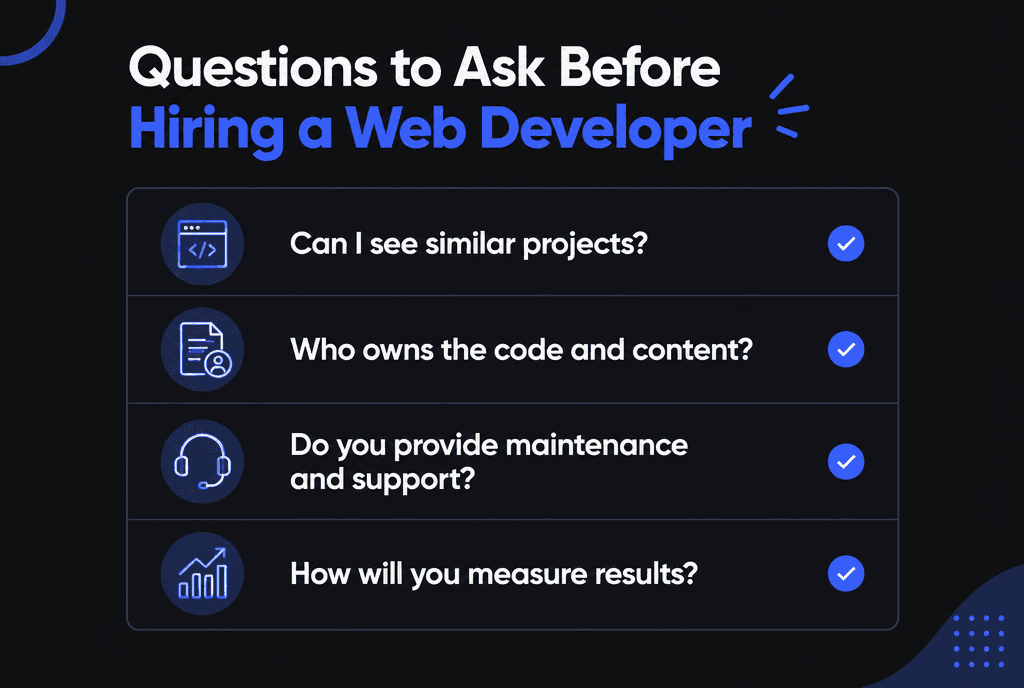
Can you show similar projects and the results they produced?
Who exactly will work on our project, and who is our main contact?
What are the steps from discovery to launch, and what do you need from us?
How do you approach mobile speed, SEO and accessibility?
Which platform will you use, and can our team update content?
Who will own the domain, design files, code and content?
What does support look like after launch, and what does it cost?
How will we measure whether the website is working?
Step 6: How do you check references and reviews?
Speak with two or three past clients, ideally with projects similar to yours. Ask about communication, deadlines, budget accuracy, problems and how they were handled, and whether they would hire the company again.
Read reviews on independent platforms as well as the company's own site, and look for patterns rather than single complaints. You can also check for complaint history with organizations such as the Better Business Bureau.
Step 7: What should the contract include?
Scope and deliverables, timeline and milestones, payment schedule, revision limits, content responsibilities, ownership transfer, support terms, confidentiality and what happens if either side ends the project early.
Ownership is where many businesses get caught out. The U.S. Copyright Office explains what copyright protects; in commissioned work, copyright generally stays with the creator unless an agreement transfers it. Make sure your contract transfers ownership of the design, code and content to your business once paid. Tie payments to milestones, such as a deposit, design approval and launch, rather than paying everything upfront. For large projects, have your own advisor review the agreement.
How do you protect your domain and accounts?
Register the domain in your business name, keep administrator access to hosting, CMS, analytics and Google Business Profile, and store copies of brand assets and content in your own accounts.
ICANN's information for domain name registrants explains your rights as a domain owner. If a company insists on registering your domain for you, ask that it be registered to your business with your contact details, and confirm you can log in.
What does a good development process look like?
Discovery, sitemap and content planning, design, development, testing, launch and post-launch support, with clear approvals at each stage and regular progress updates.
A good company tells you what it needs from you and when, warns you early about risks to the timeline and documents decisions. It tests the site on real devices, sets up tracking, runs a launch checklist and stays available after launch.
What should you expect to pay?
Professional small business websites often cost a few thousand to around $15,000, custom marketing sites more, and web applications considerably more. Price follows scope, so compare what is included rather than headline numbers.
Labor is the main cost; the U.S. Bureau of Labor Statistics lists 2025 median pay for web developers and digital designers at $47.85 an hour. See our 2026 website cost estimates and custom web development pricing breakdown.
Should you choose a freelancer, a small studio or a larger agency?
Freelancers suit simple sites and tight budgets, small studios balance cost with a broader team, and larger agencies suit complex projects that need many specialists. Match the team to the scope, not to the logo on the proposal.
Each model has trade-offs:
Freelancer: personal attention and lower rates, but one person covers everything and availability can be a risk
Small studio: designers, developers and often SEO specialists working closely together, with more dependable support
Large agency: deep specialist teams and process, but higher overhead and sometimes less senior attention on smaller accounts
Whichever you choose, confirm who will actually do the work and who you will contact when something goes wrong after launch.
What happens if a project goes wrong?
Raise concerns early and in writing, refer back to the agreed scope and timeline, and ask for a recovery plan. If the relationship cannot be repaired, make sure you can take your domain, hosting access, files and content to a new provider.
Most failed projects show early warning signs: missed check-ins, vague updates, surprise change requests or work that does not match the approved design. Addressing them at the first milestone is far easier than at launch. This is another reason to tie payments to milestones and keep administrator access to your accounts from the start. If you do need to switch providers, a new team can usually audit what exists and recommend whether to finish, fix or rebuild.
Why is Savoir Management the smart choice?
We start with your goals, put scope and ownership in writing, show results from similar projects, build fast, accessible and search-ready sites and support you after launch.

Talk to our web development team. Before you decide, read 10 signs it's time to hire a web development agency and what to know before hiring a local web developer.


