
Custom web development pricing confuses buyers because quotes for the "same" website can differ by tens of thousands of dollars. The difference is usually scope, process and what is included. This guide explains what drives cost, what you should receive and how to judge value, based on how we price projects at Savoir Management. Ranges are typical U.S. market figures, not fixed quotes.
What factors influence custom web development cost?
The number of unique templates, custom features and integrations, content and media creation, design depth, compliance needs and the level of testing and support are the main cost drivers.

Labor is the largest component. The U.S. Bureau of Labor Statistics lists 2025 median pay for web developers and digital designers at $99,520 a year, or $47.85 an hour, before agency overhead.
What are typical custom web development price ranges?
Custom-designed business websites typically cost $10,000 to $50,000. Custom web applications and SaaS platforms usually start around $50,000 and can exceed $250,000.
See our 2026 website cost estimates and how much custom web development costs for more detail.
What deliverables should you expect?
Strategy and sitemap, wireframes, custom design, responsive development, CMS, integrations, SEO and analytics setup, accessibility and speed testing, launch support, training, documentation and ownership.
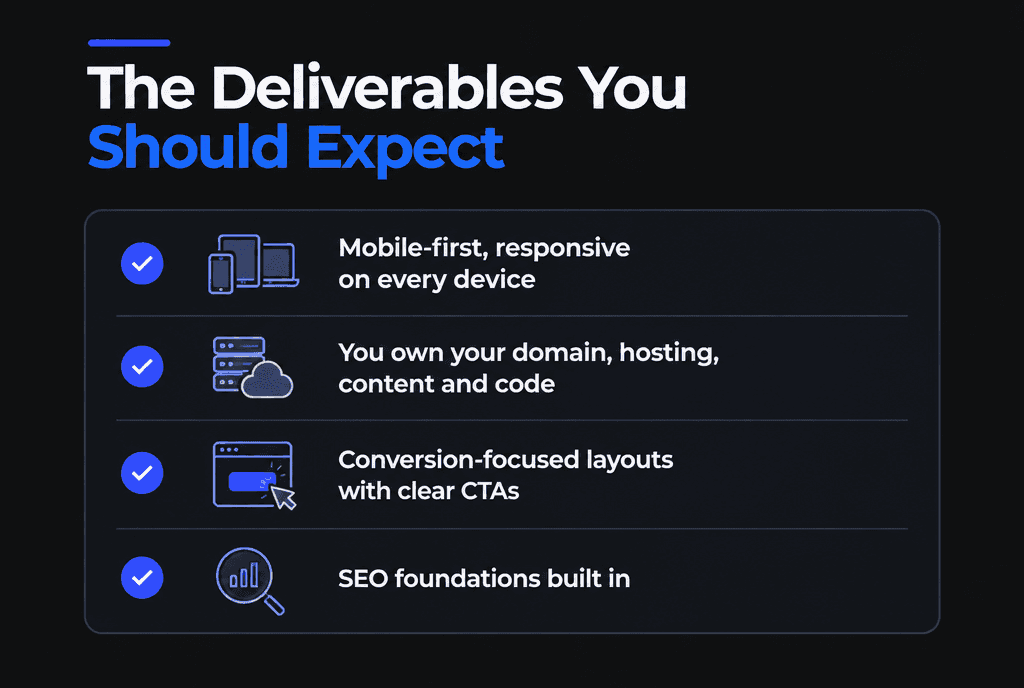
Sites built to WCAG accessibility standards
Core Web Vitals speed targets met
Forms and logins protected against the OWASP Top 10
Analytics and conversion tracking configured
Code, design and content ownership transferred to you
What misconceptions do buyers have about custom development?
Common misconceptions: custom always means expensive, a higher price guarantees better results, launch is the finish line and you can skip strategy to save money.

Custom projects can reuse proven components to control cost.
Results come from strategy and testing, not just price.
Websites need maintenance and improvement after launch.
Skipping discovery usually costs more in rework.
How are custom projects usually priced?
Most are fixed-scope projects with milestones. Hourly or sprint-based pricing suits evolving requirements and ongoing development.
Ask every provider to quote the same written scope and list what is excluded.
How does a typical custom project break down by phase?
Most custom projects divide into discovery and strategy, design, development, content and integration, testing and launch, with post-launch support after. Development is usually the largest share, but discovery and testing protect the investment.
A typical sequence:
Discovery: goals, audience research, sitemap and technical planning
Design: wireframes, visual design and prototypes for key templates
Development: building templates, components, CMS and integrations
Content: writing, editing, images and migration
Testing: devices, browsers, accessibility, speed, forms and tracking
Launch: redirects, final checks and go-live
Support: training, fixes and ongoing improvements
Skipping discovery or testing to save money usually costs more later in rework and lost results.
What questions should you ask about a custom quote?
Ask what is included and excluded, how many unique templates and revision rounds are covered, who provides content, how changes are priced, what testing is done, what support follows launch and who owns the result.
Clear answers turn a single number into a plan you can evaluate. If two quotes differ widely, these questions usually reveal why.
How do custom projects handle change requests?
Changes outside the agreed scope are usually estimated separately and approved before work begins. A clear change process keeps budgets predictable without blocking good ideas.
Keep a list of new ideas during the project and decide together which belong in the current phase and which can wait. Small changes can often be absorbed; larger ones should be scoped and priced.
What ongoing costs come with a custom site?
Hosting, domain renewal, software licenses, maintenance, security updates, backups and improvements. Many businesses budget 10% to 20% of the build cost per year.
Custom features need maintenance as browsers, platforms and integrations change. A maintenance plan keeps the site secure and working, and gives you a predictable cost.
How do you compare a custom build with templates or builders?
Templates and builders cost less upfront but may limit features, speed, SEO and growth. Custom builds cost more but fit your goals and can scale. Compare three-year costs and expected results, not just launch price.
Our comparisons of website builders vs web developers and DIY vs professional web development explain the trade-offs in detail.
Which deliverables protect your long-term investment?
Ownership of code, design files and content, documentation, admin access to all accounts, training for your team and a clean handover if you change providers.
Ask for these in writing. They make future changes cheaper, protect you if your provider changes and are often required in investor or acquisition due diligence. Our guide to choosing a web development company explains how to protect ownership.
How does accessibility and performance work affect price?
Building accessibility and performance in from the start adds modest cost; fixing them after launch costs much more. Both affect legal risk, conversions and search visibility, so treat them as core deliverables.
Ask how the provider tests against WCAG and Core Web Vitals, and request results as part of launch.
How can you reduce custom development costs?
Prepare content, limit unique templates, reuse proven components, phase advanced features and consolidate feedback. These steps lower hours without lowering quality.
Our guide to affordable custom web development covers each strategy with examples.
What do different budget levels typically get you?
Lower budgets usually buy a template-based site with light customization. Mid-range budgets fund custom design of key templates, professional content and integrations. Higher budgets cover fully custom design, complex features, large content migrations and extensive testing.
Thinking in tiers helps match expectations to budget:
Entry level: a proven template customized with your brand, core pages, contact forms and basic SEO
Mid-range: custom designs for the main templates, copywriting support, booking or CRM integrations, speed and accessibility work, and analytics
Higher end: fully custom design system, complex functionality such as portals or configurators, large migrations, multilingual content and ongoing optimization
Choose the tier that fits the role the website plays in your revenue. A site that generates most of your leads justifies more investment than a simple online brochure.
How long does a custom project take?
Most custom business websites take two to four months, depending on scope, content readiness and approval speed. Projects with complex integrations or large migrations take longer.
Timelines slip most often because of content and feedback, not development. Agree on review deadlines and assign one decision-maker to keep the project, and the budget, on track.
How are payments usually scheduled?
Custom projects are commonly paid in stages: a deposit to start, a payment at design approval and the balance at launch. Larger projects may use monthly or sprint-based billing.
Milestone payments align cost with progress and reduce risk for both sides. Be cautious of providers asking for full payment before work begins, and make sure each milestone has clear deliverables you can review. For ongoing development after launch, a monthly retainer or a bank of hours keeps budgeting predictable.
How do you think ROI, not just cost?
Estimate the leads or sales the site should produce, assign a value and compare it to total cost of ownership. A site that costs more but converts twice as well is the better investment.

For leaner options read affordable custom web development and cost-effective web development. Our custom web development team provides fixed-scope quotes.


