
A realistic website development cost estimate for 2026 depends on what the website must do. A five-page site for a local service business and a custom customer portal are different products with very different prices. These ranges reflect professional U.S. teams and what we see across projects at Savoir Management. They are typical ranges, not fixed quotes.
Why are web development costs rising?
Skilled labor, higher expectations for speed, accessibility, security and integrations, and more tools and licenses push costs up. Sites now do more work for the business, and that takes more expertise.

Labor is the largest cost. The U.S. Bureau of Labor Statistics lists 2025 median pay for web developers and digital designers at $99,520 a year, or $47.85 an hour, before agency overhead.
What factors influence web development costs?
The number of unique page templates, custom features, integrations, content creation, design depth, platform and the level of testing and support all change the price.
Templates: each unique layout requires design and development.
Features: booking, memberships, calculators, portals.
Integrations: CRM, payments, inventory, marketing tools.
Content: copywriting, photography, video and migration.
Compliance: accessibility to WCAG and security against the OWASP Top 10.
What is the average website development cost in 2026?
Typical 2026 ranges: small business sites $3,000 to $15,000; custom marketing sites $15,000 to $50,000; e-commerce stores $5,000 to $50,000+; custom web applications $50,000 and up.
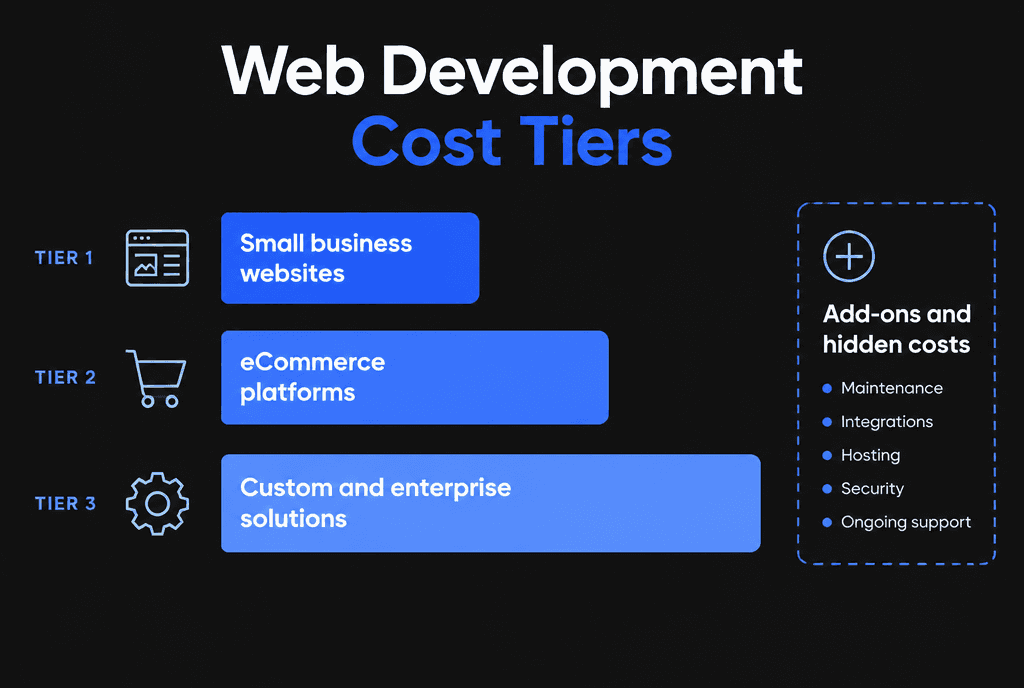
Starter or template-based site: $1,500 to $5,000
Professional small business site: $3,000 to $15,000
Custom marketing site: $15,000 to $50,000
E-commerce store: $5,000 to $50,000+ (platform fees extra; see Shopify pricing)
Custom web app or SaaS: $50,000 to $250,000+
Why do cheap websites cost more in the long run?
Cheap builds often skip strategy, speed, SEO, accessibility and tracking. They produce fewer leads and often need a rebuild within a few years, so the total cost is higher than doing it right once.

What ongoing costs should you budget for?
Budget about 10% to 20% of the build cost per year for hosting, licenses, security updates, backups and improvements. Sites that are not maintained slow down, break and lose rankings.
How do you maximize ROI on your website?
Spend on what produces revenue: messaging, conversion paths, speed and the pages buyers visit most. Track leads and sales in analytics and improve the weakest pages first.
Set up Google Analytics conversions before launch, and meet Core Web Vitals targets.
How do costs differ by platform?
Site builders have low upfront costs and ongoing subscriptions, WordPress sites have moderate build costs plus hosting and maintenance, Shopify stores combine build costs with monthly plans and apps, and custom-coded sites cost the most upfront but offer full control.
The platform affects both build and running costs. WordPress is free software, but themes, plugins, hosting and maintenance add up. Shopify's plans start at $29 a month, with apps and payment fees on top. Custom applications need ongoing development and hosting. Choose based on what the website must do and who will maintain it, then compare three-year costs.
How do design choices affect price?
Template-based designs cost least, customized templates cost more, and fully custom designs with unique layouts, illustrations and animations cost most. Each unique page template adds design and development time.
A site with fifteen pages might need only five unique templates, such as home, service, about, article and contact. Reusing templates keeps costs down without making the site look generic. Spend custom design effort on the pages that matter most for conversions.
How does content affect the budget?
Professional copywriting, photography and video add cost but often deliver the biggest improvement in results. Providing your own content saves money, but quality and timing matter.
Content is frequently underestimated. A small business site might need thousands of words of copy, team and workplace photos and product images. If you write drafts yourself, budget for editing. If content is late, the project stalls, which can add cost.
What are typical costs for specific features?
Feature costs vary widely, but booking systems, e-commerce, member areas, custom calculators, multilingual content and CRM integrations each add meaningful time. Off-the-shelf tools cost less to integrate than custom builds.
Ask providers to price features separately so you can decide what belongs in phase one. Using proven tools for booking, payments and email, rather than building them from scratch, usually saves money and reduces risk.
How should you budget for maintenance?
Budget roughly 10% to 20% of the build cost per year for hosting, licenses, security updates, backups and small improvements. Larger or more complex sites may need more.
Maintenance prevents slowdowns, broken features and security problems. Many providers offer monthly plans that include updates, monitoring, backups and a set amount of content changes. Our guide to cost-effective web development explains why skipping maintenance usually costs more.
How do timelines affect cost?
Rushed timelines can increase cost because teams must add people or work overtime. Realistic timelines with prepared content and fast approvals keep costs predictable.
A typical small business site takes six to twelve weeks. If you need a site quickly, a focused scope helps; our guide to getting a website built in 7 days explains what is realistic.
How do you get the most value from your budget?
Focus spending on what wins customers: clear messaging, conversion paths, mobile speed, SEO foundations and tracking. Phase nice-to-have features after launch.
Start with the core pages and conversion path, measure results and invest in the improvements data supports. Our custom web development pricing breakdown shows what deliverables to expect at each price level.
What red flags appear in website quotes?
Very low prices with vague scope, no mention of content, SEO, testing or support, unclear ownership terms and pressure to sign immediately. These often lead to extra costs later.
Ask what is excluded as well as what is included. A quote that leaves out copywriting, redirects, analytics setup or training will cost more once those needs appear. Our guide to choosing a web development company lists more warning signs.
Is it cheaper to redesign or rebuild?
A redesign on the same platform can cost less if the structure, content and technology are sound. A rebuild is often cheaper long term when the platform is outdated, slow, insecure or unable to support features you need.
Get an audit before deciding. If the main problems are visual design and messaging, a redesign can solve them efficiently. If the site is built on an unsupported theme, relies on many fragile plugins or fails Core Web Vitals across every template, patching may cost more than starting fresh. Factor in redirects and SEO protection for either path; our website redesign checklist covers the planning.
How do you plan a website budget for the year?
Combine the build or redesign cost, monthly hosting and maintenance, software licenses, content creation and a small reserve for improvements. Review the budget quarterly against results.
Treat the website as an ongoing investment, not a one-time purchase. A predictable annual budget keeps the site current and lets you act quickly on opportunities, such as a new service page or campaign landing page, without waiting for the next redesign.
Why work with Savoir Management?
We scope projects around business goals, give transparent fixed-scope quotes and include speed, SEO and tracking in every build.

For deeper breakdowns read how much custom web development costs, our custom web development pricing breakdown and cost-effective web development.
How do you stop guessing and start building?
Write down your goals, must-have features and content plan, get two or three quotes on the same scope and choose the partner who explains how the site will pay for itself.

Our web development team provides scoped estimates for websites, stores and web apps.


