
Web development for marketing agencies affects every result you report. Ads, SEO and social bring the clicks, but the website decides whether those clicks become clients, for your agency and for every account you manage. This guide covers the development tactics we see working for agencies, from the white-label and partner work we do at Savoir Management.
Why do agencies need strong web development?
Campaign performance depends on landing experience. A slow, unfocused or poorly tracked page wastes the budget an agency worked hard to optimize, and clients blame the campaign.
Which tactics turn clicks into clients?
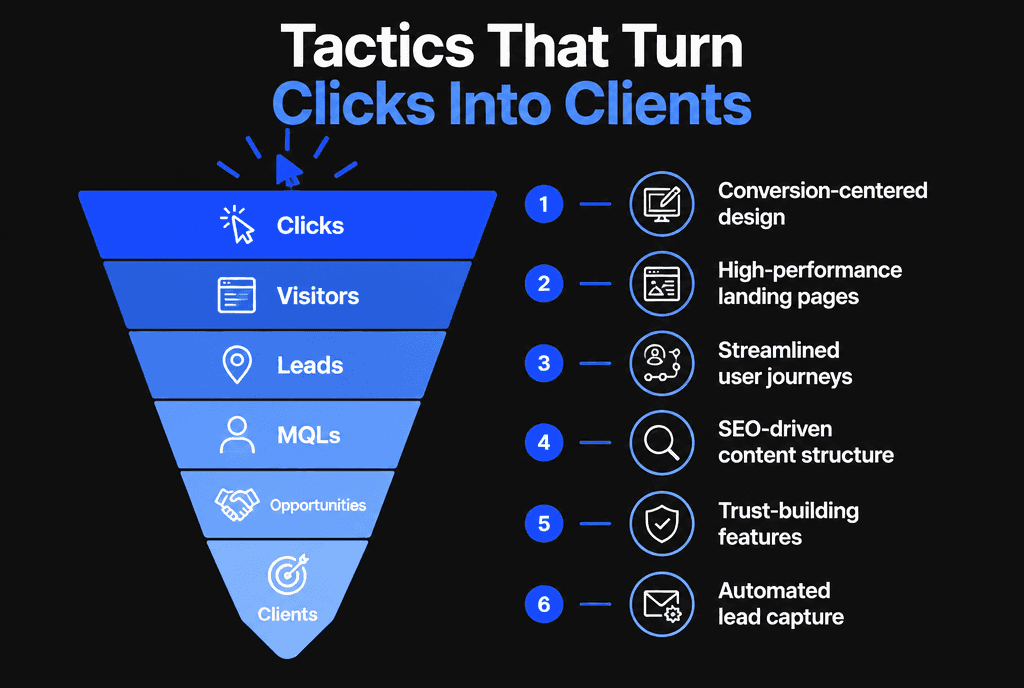
Message-matched landing pages, clear offers, social proof near the call to action, short mobile-friendly forms and fast pages. These tactics lift conversion rates across channels.
One landing page per campaign or ad group theme
Headline that repeats the promise in the ad
Testimonials, logos or reviews beside the form
Click-to-call and short forms on mobile
Read our guide to high-converting landing pages.
How should agencies measure what matters?
Track conversions consistently across every client site: form submissions, calls, bookings and purchases, with source data passed to the CRM. Without reliable tracking, agencies cannot prove ROI.

Use Google Tag Manager to deploy tags, GA4 recommended events for key actions and Google Ads conversion measurement for paid campaigns.
How does page speed affect campaign results?
Slow pages lose paid visitors before they see the offer, raising cost per lead. Meet Core Web Vitals targets on every landing page.

Targets from web.dev: LCP within 2.5 seconds, INP of 200 milliseconds or less and CLS of 0.1 or less. See our site speed guide.
What should an agency's own website include?
A clear niche and outcome, case studies with real metrics, services and engagement models, team and process, useful insights and an easy way to book a strategy call.
Google's guidance on helpful, people-first content applies to agency insights too: share first-hand results and methods.
What is the cost of ignoring these tactics?
Higher cost per lead, weaker reporting, unhappy clients and churn. Agencies that control landing experience and tracking keep clients longer.

Should agencies white-label web development?
White-label development lets agencies offer websites and landing pages without hiring a dev team, while keeping strategy and client relationships. Choose a partner with fast turnaround, clear processes and strong QA.
How should agencies standardize client websites?
Build a reusable component library, page templates and launch checklists so every client site starts from proven foundations. Standardization speeds delivery, improves quality and makes maintenance easier.
Agencies that rebuild everything from scratch for each client spend more and deliver less consistently. A shared design system with tested components for headers, forms, testimonials, pricing tables and calls to action lets designers customize the look while developers reuse reliable code. Pair it with standard tracking setups and a launch checklist so nothing is forgotten.
How do agencies manage client approvals efficiently?
Agree on one decision-maker per client, set review rounds and deadlines in the contract, use clickable prototypes for feedback and collect comments in one place. Clear approvals prevent endless revisions.
Many agency projects lose margin in feedback loops. Present work with context: the goal of each page, the audience and the reasoning behind design choices. Ask for consolidated feedback, and log decisions so they are not reopened later.
What should agencies include in maintenance retainers?
Software updates, backups, security monitoring, uptime checks, small content changes, monthly performance reports and a set number of improvement hours. Retainers create recurring revenue and keep client sites performing.
A clear retainer protects both sides. Define response times, what counts as a small change and how larger requests are quoted. Include a short monthly report showing updates performed, speed and uptime, and conversions, so clients see the value.
How do agencies prove website ROI to clients?
Set baselines before launch, track conversions and revenue from the website, compare periods after changes and report on business outcomes rather than traffic alone.
Connect website conversions to the client's CRM or sales data where possible, so reports show leads and customers, not just sessions. Use Google Analytics recommended events for consistent tracking across clients, and annotate reports with major changes so results are easy to explain.
How should agencies handle client ownership and access?
Make sure clients own their domains, hosting accounts, analytics and ad accounts, with the agency added as a user. Transparent ownership builds trust and avoids disputes if the relationship ends.
Document every account, who owns it and who has access. Agencies that hold client assets hostage damage their reputation; agencies that make ownership clear tend to keep clients longer because the relationship is based on results.
How do agencies scale web delivery without hiring too fast?
Combine an internal core team for strategy and client relationships with trusted development partners for peak workloads. White-label partners let agencies take on more projects without fixed payroll.
Choose partners who follow your standards, communicate clearly and can work within your tools and timelines. Start with a smaller project to test the fit before committing major clients.
Which agency website mistakes cost new business?
Generic positioning, no case studies with numbers, slow pages, hidden pricing or process information and outdated portfolio work. An agency's own site is its most visible proof of capability.
Update case studies regularly, show results and specialize where possible. Our guide to portfolio website development shares principles that apply to agency portfolios too.
How do agencies combine web and paid media services?
Agencies that manage both landing pages and campaigns control the full path from click to conversion, which usually produces better results and easier attribution than splitting responsibilities.
When the same team writes the ad and the page, message match improves and tests can cover both. Google Ads Quality Score includes landing page experience, so better pages can also make campaigns more efficient.
How should agencies price web development?
Most agencies price websites as fixed-scope projects based on templates, features and content, then add monthly retainers for maintenance and optimization. Value-based pricing works when the website's business impact is clear.
Fixed scopes protect clients' budgets and agencies' margins when requirements are well defined. A paid discovery phase helps scope complex projects before committing to a fixed price. Track actual hours against estimates on every project to improve future quotes. Retainers for maintenance, landing pages and conversion optimization create steady revenue and keep agencies involved after launch, which often produces better results for clients.
How do agencies win more website projects?
Specialize by industry or outcome, publish case studies with measurable results, share useful insights and make it easy for prospects to book a call. Referrals from happy clients remain one of the strongest sources.
Ask satisfied clients for referrals and reviews at the end of successful projects. Partnerships with complementary agencies, such as branding or PR firms, can also bring steady web development work.
How does Savoir Management help agencies win?
We build fast, tracked, conversion-focused sites and landing pages for agencies and their clients, as a white-label or co-branded partner.

Our web development team partners with agencies. Related guides: conversion-focused web development, web development for lead generation and fast-turnaround web development.


