Meta ads for e-commerce remain one of the fastest ways to grow an online store, and online shopping keeps growing. The U.S. Census Bureau's quarterly e-commerce report shows e-commerce accounted for 16.4% of total retail sales in Q2 2026, not seasonally adjusted. Winning that demand on Facebook and Instagram depends on tracking, structure, creative and disciplined scaling. Here is the playbook we use for e-commerce clients at Savoir Management.
Why do Meta ads work for online stores?
Meta ads work for online stores because they reach people before they search, show products visually in the feed, Stories and Reels, and optimize delivery toward people likely to buy. Search captures existing demand; Meta creates new demand.
Meta targets "discovery intent": people who did not know they needed your product until they saw it. That makes creative and offer more important than keywords.

How should e-commerce tracking be set up on Meta?
Install the Meta Pixel with standard e-commerce events, add the Conversions API from your server or platform integration, and verify that purchase values are passed correctly. Meta can only optimize for the purchases it can see.
Meta Pixel: ViewContent, AddToCart, InitiateCheckout, Purchase with value and currency.
Conversions API: server-side events for more reliable measurement.
Product catalog connected to Commerce Manager for dynamic ads.
How should you structure Meta campaigns for e-commerce?
Use three layers: prospecting to reach new buyers, retargeting to convert visitors, and retention to bring back customers. Keep audiences from overlapping so each layer has its own budget and message.
Prospecting: broad targeting and look-alike audiences of purchasers, optimized for purchases.
Retargeting: product viewers and cart abandoners via custom audiences. See our Meta retargeting strategy.
Retention: past buyers with new arrivals, bundles and replenishment offers.

Why is creative the biggest lever on Meta?
Because Meta's targeting is increasingly automated, creative decides who sees your ad and whether they stop scrolling. Testing new hooks, formats and angles every week is the most reliable way to lower cost per purchase.
Creative formats that sell products:
User-generated video: real customers unboxing or using the product.
Problem and solution: a frustration solved in 15 seconds.
Comparison: your product versus the usual alternative.
Social proof: reviews, ratings and press quotes over product footage.
Catalog and carousel ads: many products, dynamically matched to interest.
Use Meta's A/B testing to compare one variable at a time.
How do you set budgets and bids for e-commerce?
Start with enough budget for your main campaign to get roughly 50 purchases a month, use lowest-cost bidding until you have data, and set a target ROAS based on your margins. Break-even ROAS equals 1 divided by gross margin.
Example: with a 40% gross margin, break-even ROAS is 1 / 0.40 = 2.5. Anything below 2.5 loses money on the first order unless repeat purchases make up the difference.
How do you scale Meta ads profitably?
Scale vertically by raising budgets about 20 to 30% at a time on campaigns that hit target, and horizontally by adding new audiences and creatives. Big budget jumps often push delivery into less efficient inventory.
Scale only after several days of stable results.
Add new creatives before raising budgets, not after performance drops.
Watch blended metrics such as total revenue divided by total ad spend, not only platform ROAS.

Which mistakes stall e-commerce growth on Meta?
The most common mistakes are scaling too fast before you have data, ignoring creative fatigue, targeting too narrowly or too broadly without testing, and running the same ad for months.
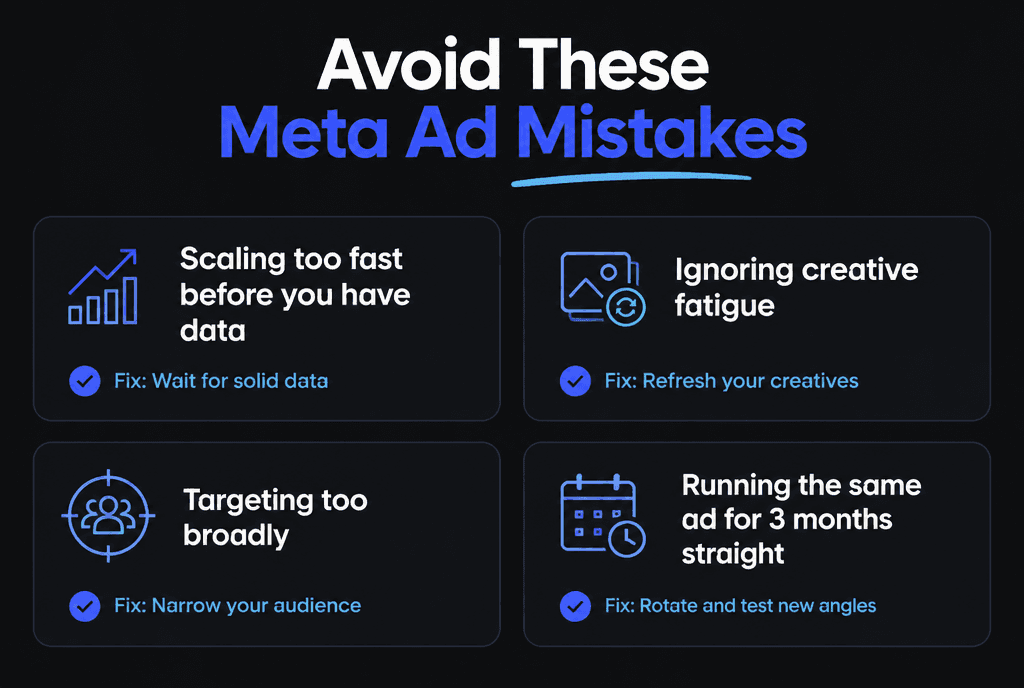
Another hidden mistake is the store itself. If product pages load slowly or checkout is confusing, Meta's traffic will not convert. Baymard Institute puts the average documented cart abandonment rate at 70.22%, so checkout fixes often pay off faster than new ads. Our guides to e-commerce websites that increase sales and Shopify vs WooCommerce cover the store side.
How do you know your Meta ads are working?
Track ROAS, cost per purchase, average order value, new versus returning customer revenue and contribution margin after ad spend. If ad-attributed revenue grows but total revenue does not, you are paying for sales you would have made anyway.
Review weekly and confirm results in your store analytics. Meta's ad auction rewards relevant, high-quality ads, so creative quality also shows up as lower costs.
Need a partner? Our Facebook and Instagram ads team runs e-commerce accounts end to end. For short-form video, compare results with TikTok ads for small business.