
Shopify vs WooCommerce is the most common platform question we hear from store owners at Savoir Management. Both power successful stores. The right choice depends on how much control you want, who will maintain the site, your budget and whether content plays a big role in your marketing. This comparison covers the differences that matter.
Why does your platform choice matter?
Your platform affects costs, speed, design freedom, integrations, who maintains the site and how easily you can grow. Switching later is possible but takes time, so choose with the next three to five years in mind.
What is the big picture?
Shopify is a hosted, all-in-one commerce platform. WooCommerce is a free plugin that turns a WordPress site into a store. Shopify trades flexibility for convenience; WooCommerce trades convenience for control.
What does Shopify offer as an all-in-one option?
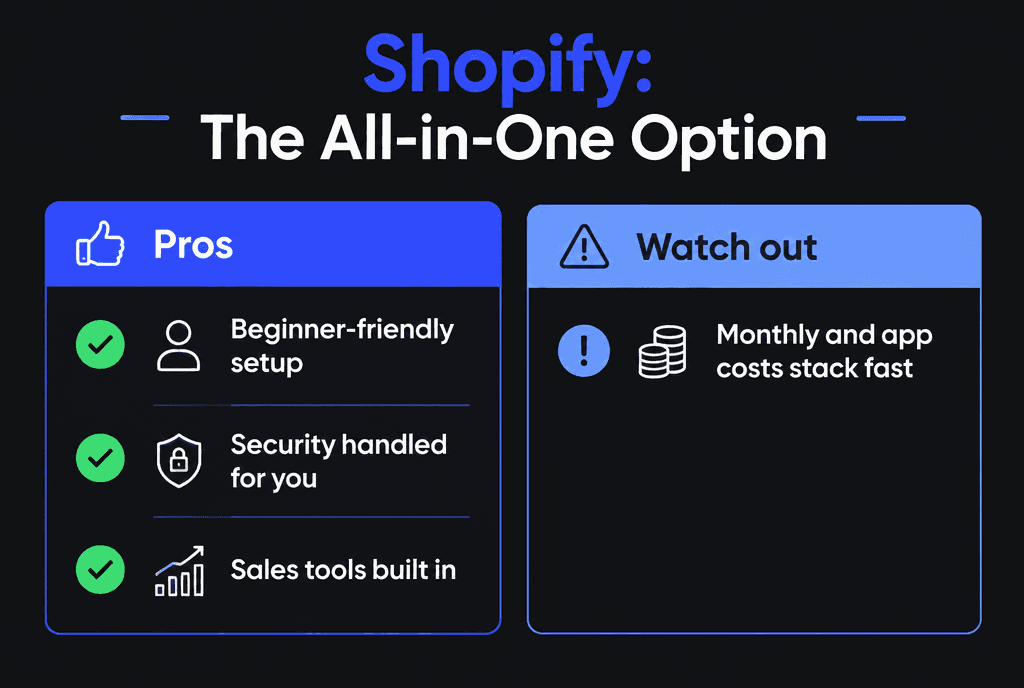
Shopify includes hosting, security, checkout, payments and updates in a monthly plan, with a large app and theme marketplace. Current plans are Basic $29, Grow $79 and Advanced $299 a month, and Shopify Plus starts at $2,300 a month.
See Shopify pricing for current plan details, and Shopify's subscriptions documentation if you sell recurring products.
Pros: fast setup, reliable hosting, strong checkout, minimal maintenance
Cons: monthly fees and app costs, less code-level control, some features need apps
What makes WooCommerce the customizable option?
WooCommerce is free and open source, runs on WordPress and gives full control over code, hosting and data. You can customize nearly anything, but you are responsible for hosting, security, updates and paid extensions.

Get it from the WordPress plugin directory and browse the WooCommerce extension marketplace. WordPress powers about 40% of all websites according to W3Techs.
Pros: full control, no platform fee, excellent for content-led stores
Cons: you manage hosting, security and updates; extension costs add up
How do Shopify and WooCommerce compare on key factors?
Shopify wins on ease of use and maintenance; WooCommerce wins on flexibility and ownership. They are close on SEO potential, and total cost depends on apps, extensions and who maintains the site.

Cost: Shopify has predictable monthly fees; WooCommerce costs hosting, extensions and maintenance.
Ease of use: Shopify is simpler for non-technical teams.
Customization: WooCommerce allows full code changes; Shopify uses themes, apps and APIs.
SEO: both support strong SEO; follow Google's e-commerce SEO best practices and add product structured data.
Speed: both can be fast; heavy apps, plugins and themes slow either one. Check Core Web Vitals.
Maintenance: Shopify handles updates; WooCommerce needs ongoing care.
Which platform fits your business best?
Choose Shopify if you want to launch quickly, prefer low maintenance and sell standard products. Choose WooCommerce if you already run WordPress, publish a lot of content, need deep customization or want full ownership of your stack.

How does Savoir Management help you choose and build?
We map your products, integrations, team skills and growth plans, recommend the platform with the lowest total cost for your goals, then build a fast, conversion-focused store on it.
Our Shopify development team and WordPress development team build and migrate stores. Read e-commerce upgrades that increase sales, how to build an e-commerce website that converts and why WordPress still leads for business.


