User experience web development services focus on a simple idea: a site that is easy to use sells more. You can buy more traffic, or you can convert more of the traffic you already have. UX-driven development does the second. This guide explains the business case, the process and the mistakes we see most often at Savoir Management.
What is the business case for UX-driven development?
UX improvements raise conversions on existing traffic, reduce support requests and make every marketing dollar work harder. Because they compound across all channels, they are often the highest-return website investment.
Visitors decide fast. Nielsen Norman Group found that users often leave pages within 10 to 20 seconds unless the page communicates clear value. UX makes that value obvious.

How does UX-driven development work?
It follows a cycle: research users, define their key tasks, design the structure and flows, prototype and test with real people, build, measure and iterate. Decisions are based on evidence, not opinions.
Research: interviews, analytics, support tickets and search queries.
Information architecture: organize content around user tasks and language.
Wireframes and prototypes: test layouts before visual polish.
Usability testing: watch real users attempt key tasks.
Build and measure: launch, track conversions and keep improving.
What usability principles should every site follow?
Clear navigation, consistent design, visible feedback, error prevention and recognition over recall are the core principles. Nielsen Norman Group's 10 usability heuristics remain the standard checklist.
Review key pages against the 10 usability heuristics. Write for scanners: people often read in patterns such as the F-shaped pattern, so front-load headings and the first words of paragraphs.
Which UX mistakes cost companies conversions?
Clunky navigation, overdesigned pages, slow load times and ignoring accessibility are the costliest mistakes. Each one blocks some visitors from finding information or completing a task.
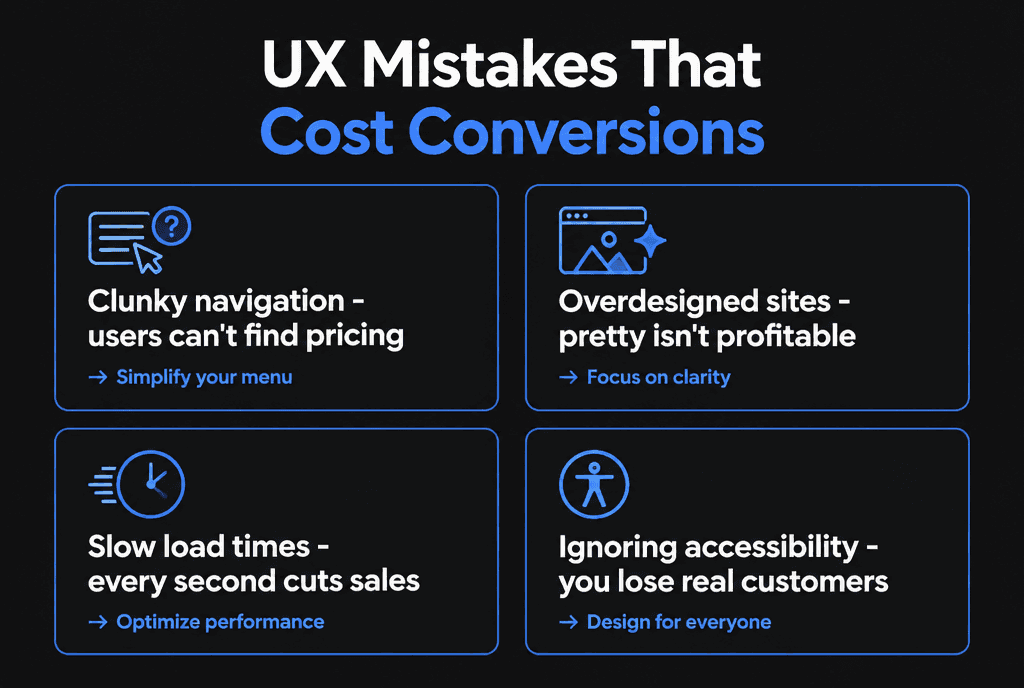
If users need a map to find pricing, navigation has failed.
Pretty is not profitable when animations hide content or slow pages.
Every extra second of loading loses impatient visitors.
Inaccessible sites exclude real customers and create legal risk.
Why is accessibility part of UX?
Accessible design makes a site usable for people with disabilities and easier for everyone: clearer contrast, keyboard support, descriptive labels and readable text help all users, especially on mobile.
The Web Content Accessibility Guidelines (WCAG) are the global standard. The W3C's introduction to web accessibility explains who benefits. Read our guide to ADA-compliant web development.
How does performance shape user experience?
Speed and responsiveness are part of UX. Pages that load slowly, shift while loading or lag after taps feel broken, even if the design is good.
Google's Interaction to Next Paint (INP) metric measures responsiveness; a good score is 200 milliseconds or less. See our site speed guide.
What is the ROI of UX-driven development?
ROI comes from higher conversion rates, larger orders, fewer support requests and lower acquisition costs. Measure it by comparing conversion rate and cost per acquisition before and after UX changes.

Example: a site with 5,000 monthly visitors converting at 1.5% produces 75 leads. Lifting conversion to 2.25% through UX fixes adds about 37 leads a month with no extra traffic.
How do you know which UX changes to make first?
Start where traffic and drop-off are both high: the homepage, top landing pages, pricing and checkout or contact flows. Fix the issues users stumble on most often in testing.
Combine analytics funnels with five-user usability tests to find the biggest problems quickly. For checkout-heavy sites, Baymard Institute's research is a useful benchmark for abandonment.
How do you get UX-driven web development?
Look for a team that starts with research, tests prototypes with users, designs for accessibility and speed, and commits to measuring results after launch.
Our web development team builds UX-driven sites, and related guides cover conversion-focused development, landing pages and website redesigns.