Recurring revenue web platform development turns one-time buyers into subscribers. Predictable monthly income makes a business easier to plan, finance and grow. But subscription platforms live or die on billing reliability, onboarding and retention, not just on the signup page. This guide explains the models, features and decisions we work through with clients at Savoir Management.
Why is recurring revenue the smartest business model?
Recurring revenue gives predictable cash flow, higher customer lifetime value and better business valuations than one-off sales. Each retained subscriber adds to next month's revenue instead of starting from zero.
It also changes priorities: retention becomes as important as acquisition, and the website becomes the product's front door, billing desk and support center.

Which recurring revenue models work on the web?
The four common models are memberships, SaaS subscriptions, subscription e-commerce and marketplaces with recurring fees. Many businesses combine them, such as a product subscription plus a paid community.
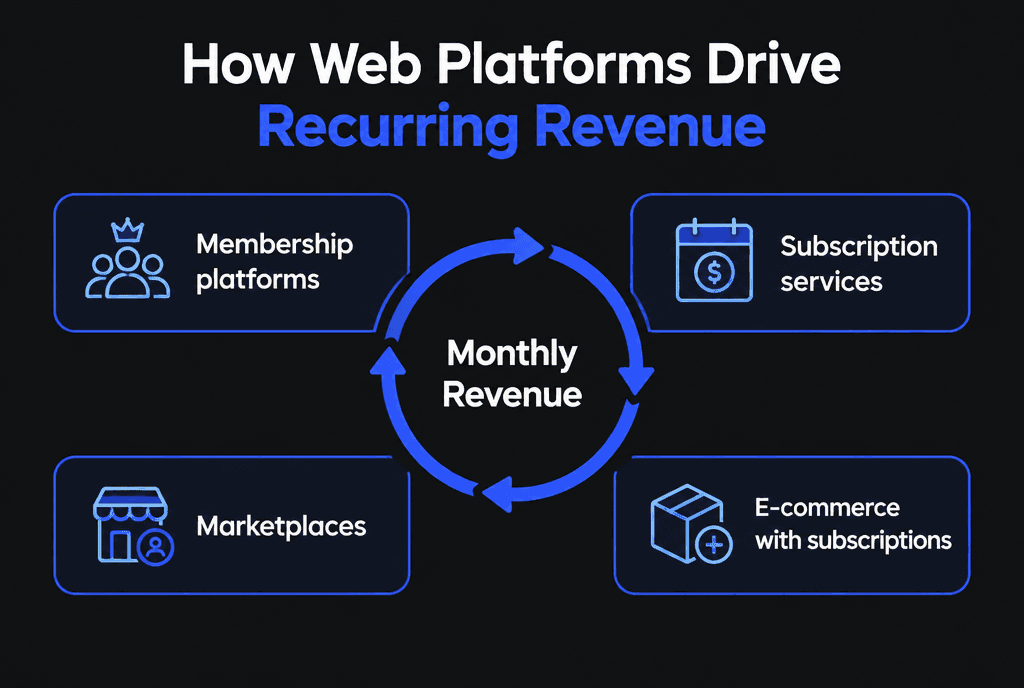
Memberships: paid access to content, courses or communities. See our guide to membership site development.
SaaS: software accessed by subscription. See our SaaS platform development guide.
Subscription e-commerce: products delivered on a schedule, using tools like Shopify Subscriptions or WooCommerce Subscriptions.
Marketplaces and directories: recurring fees from sellers or listed businesses. See directory website development.
What billing features does a subscription platform need?
It needs plans and pricing tiers, trials, upgrades and downgrades with proration, invoices and receipts, taxes, and automated recovery of failed payments. Building billing from scratch is rarely worth the risk.
Use an established billing service. Stripe's documentation explains how subscriptions work and its revenue recovery tools for failed payments.
Why does a customer portal matter?
A self-service portal lets customers update payment details, change plans, download invoices and cancel without contacting support. It lowers support costs and prevents involuntary churn from expired cards.
Stripe, for example, offers a hosted customer portal. Whatever tool you use, link it clearly from the account area.
What features keep subscribers from cancelling?
Onboarding that delivers value in the first session, regular new value, usage reminders, flexible options like pausing or downgrading, and exit surveys keep subscribers longer.
A guided first-run experience with one quick win
Progress tracking or usage summaries
Pause and downgrade options at cancellation
Win-back offers based on cancellation reasons
What legal and trust issues apply to subscriptions?
Disclose price, renewal terms and cancellation steps clearly before checkout, get explicit consent and make cancelling straightforward. Regulators and payment processors scrutinize confusing auto-renewals.
The FTC enforces rules on negative option marketing, documented on its Negative Option Rule page, and several states have their own auto-renewal laws. Review terms with counsel.
What mistakes do companies make when building platforms?
The common mistakes are custom-building billing, launching too many features before validating demand, neglecting onboarding, ignoring failed payments and tracking signups instead of retention.

Building every feature before the first paying customer
No dunning, so expired cards quietly cancel subscriptions
Pricing that does not match how customers get value
No analytics on activation and churn
Which metrics matter for recurring revenue platforms?
Track monthly recurring revenue, churn rate, activation rate, average revenue per user and customer lifetime value. Lifetime value compared with acquisition cost tells you how much you can spend to grow.
Set up Google Analytics with custom events for signup, activation and upgrade, and reconcile with billing data monthly.
How do you build a recurring revenue platform?
Validate the offer with a simple version, choose a billing system, build onboarding and the customer portal, then add retention features based on real usage data.
Our custom web development team builds subscription platforms on proven billing tools. See what custom development costs.