Google Ads for lawyers is one of the fastest ways for a law firm to reach people at the exact moment they need legal help. Someone who searches "DUI lawyer near me" at 2 a.m. is not browsing. They are ready to call. This guide explains how the ad auction prices legal clicks, which campaign types and keywords produce signed cases, and how to stay within attorney advertising rules. It is written from the campaigns we manage for law firms at Savoir Management.
How do Google Ads work for law firms?
Google Ads shows a law firm's ad at the top of search results when someone searches a keyword the firm bids on, and the firm pays only when the ad is clicked. Position and price are set by an auction that weighs your bid together with the quality of your ad and landing page, so a well-built campaign can outrank a bigger budget.
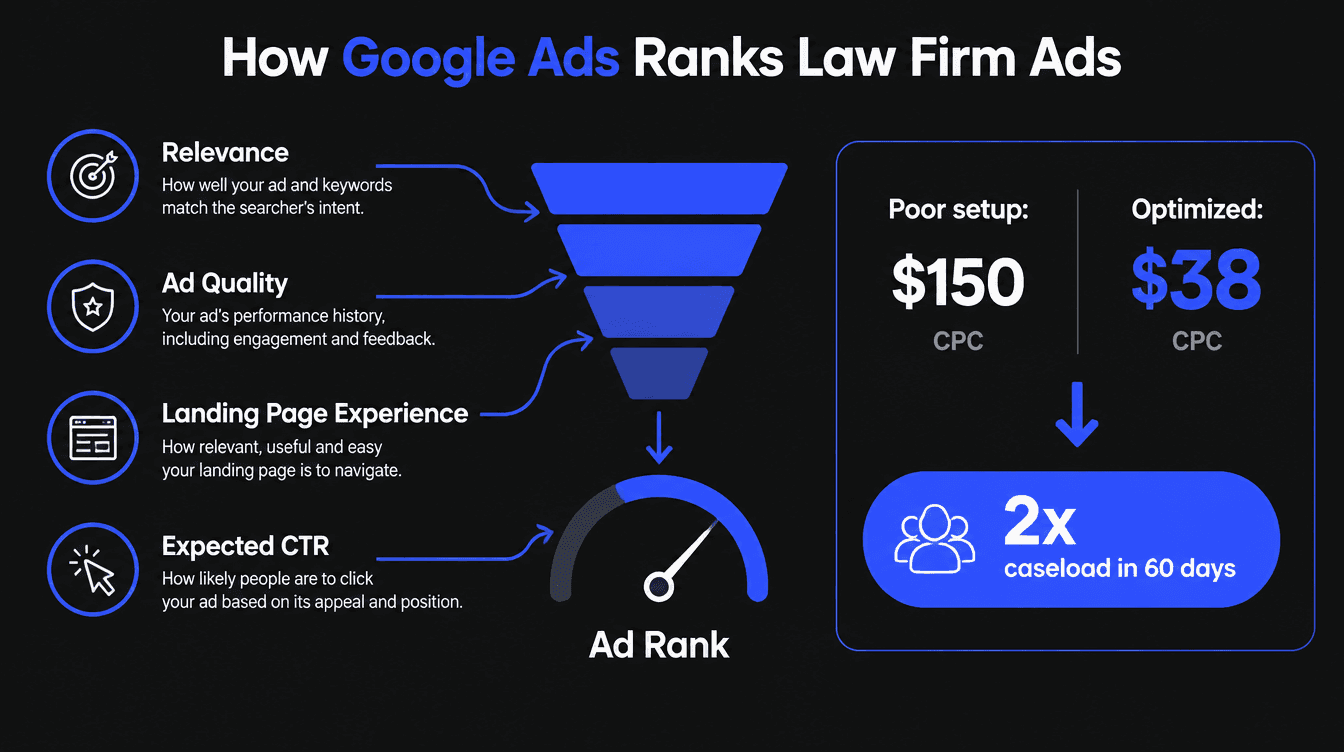
Google calls this score Ad Rank. It combines your maximum bid, the quality of your ad and landing page, the competitiveness of the auction, the searcher's context and the expected impact of your ad assets. That is why two firms bidding on "car accident lawyer" can pay very different prices for the same position.
For legal services, the searcher's intent is unusually strong. People searching "best personal injury lawyer after accident" or "divorce attorney free consultation" have a problem they want solved now. A search campaign buys access to that moment.

Why do lawyers pay so much per click?
Legal clicks are expensive because one new client can be worth thousands of dollars in fees, so many firms compete for the same small set of high-intent searches. You cannot change the market price, but you can lower your own cost with a higher Quality Score and tighter targeting.
Google rates every keyword with a Quality Score from 1 to 10 based on three components:
Expected click-through rate: how likely people are to click your ad.
Ad relevance: how closely the ad matches the search.
Landing page experience: how useful and relevant the page is after the click.
When those components improve, your Ad Rank rises without a higher bid. In one criminal defense account we rebuilt, a tighter keyword list, stronger negatives and a dedicated landing page brought the cost per click down from about $150 to $38, and the firm's caseload roughly doubled within 60 days.
Which campaign types work best for attorneys?
Most firms get the best results from Search campaigns for high-intent keywords, Local Services Ads for pay-per-lead phone calls, and remarketing to bring back visitors who did not call. Performance Max can add scale once conversion tracking is reliable.
Search campaigns: text ads on Google results for keywords like "divorce lawyer fast consultation." This is the core of most legal accounts.
Local Services Ads: appear above search ads with a Google Screened badge after Google checks your license and insurance. You pay per qualified lead rather than per click. See Google's Local Services Ads overview.
Remarketing: shows ads to people who visited your site but did not book, which matters when clients compare several firms.
Performance Max: Google's automated campaign type that runs across Search, Maps, YouTube and Gmail. It works only when it has accurate conversion data to learn from.
How should a law firm choose keywords?
Choose keywords that show hiring intent, add a location, and block anything that signals someone who will never pay for representation. Exact and phrase match keep spend on the searches you actually want.
Google offers three keyword match types: broad, phrase and exact. Broad match reaches the most searches but also the most irrelevant ones. For most law firms we start with phrase and exact match on terms such as:
"DUI attorney near me"
"car accident lawyer free consultation"
"hire employment attorney [city]"
Long-tail searches such as "wrongful termination lawyer no win no fee" usually cost less and convert better because they describe a specific situation.
Negative keywords: where most firms lose money
Negative keywords stop your ads from showing for searches you do not want. Every legal account should block terms like "pro bono," "free lawyer," "legal aid," "public defender," "law school," "paralegal jobs" and "salary." One family law firm we audited was spending about $800 a month on "free child custody help" before negatives were added.

How do you target the right clients and locations?
Target the cities and counties where you are licensed and willing to take cases, schedule ads for the hours you can answer the phone, and adjust for mobile, where many urgent legal searches happen.
Geography: a 5-mile radius for criminal defense, statewide for appellate or family law, or several metro areas for personal injury.
Ad schedule: use ad scheduling to run ads only when someone can take the call, or raise bids during evening and weekend hours if you offer 24/7 intake.
Devices: make sure every ad has a call asset so mobile searchers can tap to call without visiting your site.
What should a lawyer's Google Ads landing page include?
A legal landing page should match the ad's practice area and location, show the phone number above the fold, offer a short consultation form, and prove trust with reviews, case results and credentials. Sending ad traffic to the homepage is the most common reason legal ads fail.
Your page should:
Repeat the promise in the ad, such as "Charged with a DUI in Austin?"
Show a click-to-call button and a three-field form.
Highlight experience, bar admissions and verified reviews.
Load fast on mobile. Google treats landing page experience as part of Quality Score.
We cover the full build in our guide to law firm website development and our landing page conversion guide.

How do you write Google Ads that attorneys can legally run?
Write ads that are specific, urgent and accurate. Lead with the client's situation, add proof such as years of experience or verified reviews, and avoid claims your state bar prohibits, such as guaranteed outcomes or unapproved "specialist" titles.
ABA Model Rule 7.1 prohibits false or misleading communications about a lawyer's services, and Rule 7.2 sets rules for advertising and claims of specialization. States adopt their own versions, so check your bar's rules before launch.
Examples that work and stay compliant:
"Charged With a DUI? Talk to a Defense Attorney Tonight"
"Injured in a Crash? Free Case Review, No Fee Unless We Win"
"Divorce Attorney in Dallas, Same-Day Consultations"
Responsive search ads let you supply up to 15 headlines, and Google tests the combinations for you.
How do you measure Google Ads ROI for a law firm?
Track every phone call and form submission as a conversion, connect them to signed cases in your intake system, and judge campaigns by cost per signed case. Clicks and impressions alone tell you nothing about revenue.
Set up conversion tracking for calls from ads, calls from your website and form submissions. Then track the metrics that matter:
Cost per qualified lead
Consultation booking rate
Cost per signed case
Average fee per case, so you can compare it to acquisition cost
When those numbers are in place, you can raise budgets on the keywords that produce cases and cut the ones that only produce calls.

What mistakes do law firms make with Google Ads?
The costly mistakes are broad match without negatives, sending traffic to the homepage, no call tracking, leaving smart bidding unsupervised, and not remarketing to visitors who compared firms. Each one quietly raises cost per case.
Using broad match on every keyword
Skipping negative keywords
Sending clicks to the homepage instead of a practice-area page
Not tracking calls, so the account optimizes for the wrong thing
Letting automated bidding run without reviewing search terms weekly
Ignoring remarketing for visitors who did not call
If you want an outside review, our Google Ads management team audits legal accounts. Related reading: how to lower Google Ads CPC and the Google Ads strategy we use for conversions.