
Knowing how to lower Google Ads CPC matters because you cannot control competitors' bids, but you can control how efficiently you win the auction. Google prices clicks with Ad Rank, which rewards relevance and quality as well as bids. These nine fixes are the ones we apply first when auditing accounts at Savoir Management.
How does Google decide what you pay per click?
Google runs an auction for every search. Your Ad Rank, based on your bid, the quality of your ad and landing page, the auction context and the expected impact of assets, decides whether your ad shows and where. Better quality can win the same position for less.
Google explains the factors in its Ad Rank documentation. In practice, you pay just enough to beat the advertiser below you, so improving quality lowers the price of each position.
Fix 1: Why should you audit before changing bids?
An audit shows where money leaks before you touch bids. In many accounts we audit, a meaningful share of budget goes to irrelevant searches, duplicate keywords or ad groups that never convert.
Check:
The search terms report for irrelevant queries
Keywords with spend and zero conversions
Ad groups with mixed themes
Conversion tracking that counts the wrong actions

Fix 2: How do you raise Quality Score?
Raise Quality Score by improving its three components: expected click-through rate, ad relevance and landing page experience. Tight keyword groups, matching ad copy and focused landing pages move all three.
Google rates Quality Score on a 1 to 10 scale at the keyword level. Its own guide to using Quality Score to improve performance recommends working on whichever component is rated "below average" first.

Fix 3: How should you group keywords?
Group keywords into small themes, each with its own ads and landing page. When the ad repeats the searcher's words and the page delivers on them, relevance and CTR rise and cost falls.
Instead of one ad group for "plumbing," create separate ones for "emergency plumber," "water heater repair" and "drain cleaning," each with a matching headline and page.
Fix 4: Which match types lower wasted spend?
Phrase and exact match keep spend close to your intent. Broad match can work with smart bidding and good data, but without them it often pays for loosely related searches.
See Google's keyword matching options. We usually launch with phrase and exact, then test broad in a separate campaign once conversion data is reliable.
Fix 5: How do negative keywords lower CPC?
Negative keywords stop your ads from entering auctions you do not want. Fewer wasted clicks raise CTR and conversion rate, which supports Quality Score and lowers your effective cost.
Add negative keywords weekly from the search terms report. Common examples: "free," "jobs," "salary," "DIY," "how to become" and competitor names you do not want to target.
Fix 6: How do better ads lower costs?
Ads that match the search and stand out earn higher click-through rates, which improves expected CTR and Ad Rank. Use every headline slot in responsive search ads and include the keyword, a benefit and a reason to act.
Follow Google's best practices for responsive search ads: add as many unique headlines and descriptions as you can, try varied headline lengths, and include prices, promotions or exclusives where relevant.
Fix 7: How does the landing page affect CPC?
Landing page experience is part of Quality Score. Pages that load fast, match the ad and make the next step obvious earn better ratings and convert more clicks into customers.
Google's Core Web Vitals set targets for loading (Largest Contentful Paint within 2.5 seconds), responsiveness (INP of 200 milliseconds or less) and visual stability (CLS of 0.1 or less). Our guide to improving site speed and our landing page development guide cover the fixes.
Fix 8: Should you use smart bidding?
Use smart bidding once conversion tracking is accurate. Strategies like Target CPA and Target ROAS optimize for results, not clicks, and often lower cost per conversion even if individual clicks cost more.
Read Google's overview of Smart Bidding. Keep oversight: review search terms and placements weekly, because automation optimizes for the signal you give it.

Fix 9: How do schedules and bid adjustments help?
Show ads when your buyers convert and reduce spend when they do not. Ad scheduling and bid adjustments by device and location shift budget toward the most profitable hours and places.
Use ad scheduling to pause ads outside business hours if you rely on calls, and bid adjustments for devices or locations that convert better.
What mistakes keep CPC high?
The usual culprits are broad match without negatives, ignoring ad relevance and Quality Score, never testing landing pages and overbidding to stay in position one.
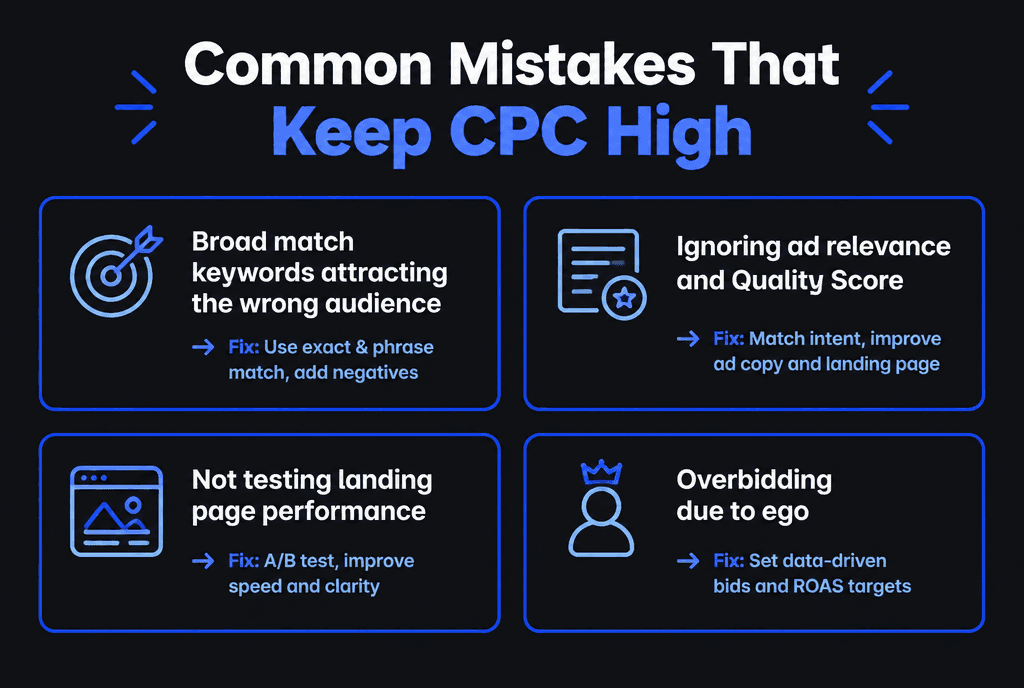
Position one is not always profitable. Positions two and three often deliver a lower cost per conversion. For a full campaign plan, see the Google Ads strategy we use for conversions and how to launch a profitable campaign, or ask our Google Ads team for an audit.


