Google Ads for real estate agents works because home sellers and buyers search with clear intent. A homeowner typing "what is my home worth in Plano" is closer to listing than anyone scrolling social media. This guide covers the keywords that bring listings, the housing ad rules you must follow, how to build a landing page that converts, and what budget to expect. It reflects the campaigns we run for agents at Savoir Management.
Why should real estate agents use Google Ads?
Google Ads puts an agent in front of people actively searching to buy or sell a home in a specific area, at the moment they search. Unlike postcards or social posts, every click comes from someone who described what they want.
Search ads also give you control. You choose the neighborhoods, the hours ads run and the exact phrases you appear for, and you pay only when someone clicks. With conversion tracking in place, you can see which keywords lead to appointments and listings.

How does Google Ads work for real estate?
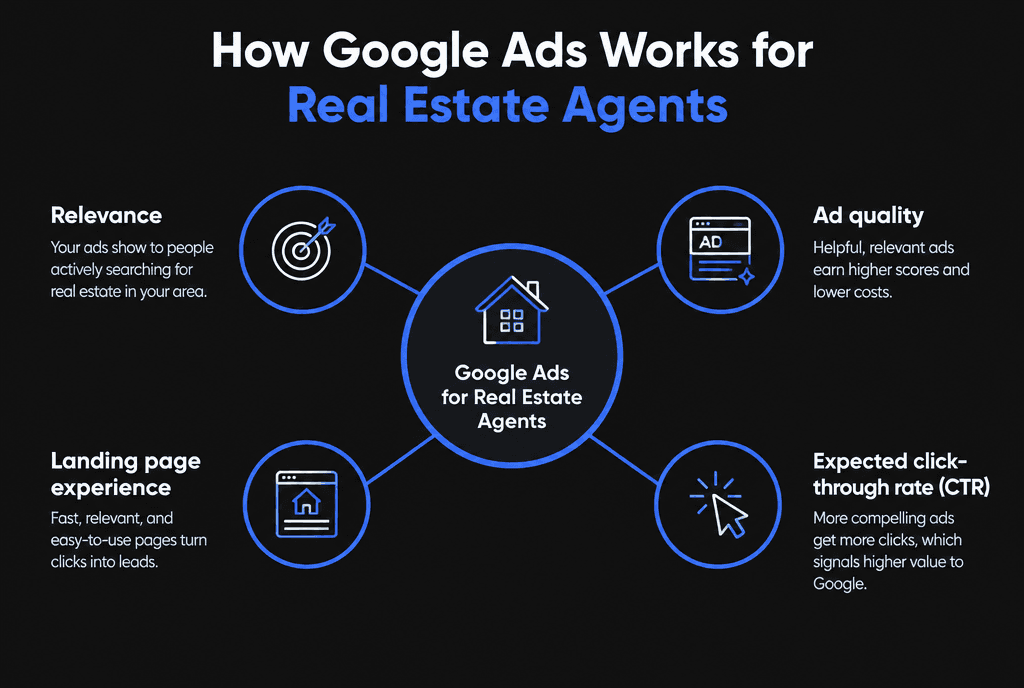
Each search triggers an auction. Google ranks ads by Ad Rank, which combines your bid with ad quality and landing page experience, so a relevant ad and page can outrank a competitor who bids more.
Google scores ad quality with a Quality Score from 1 to 10, built from expected click-through rate, ad relevance and landing page experience. Ad Rank uses that quality along with your bid and the searcher's context. Improving relevance is the cheapest way to lower your cost per lead.
What housing ad rules do real estate agents need to follow?
Housing ads in the U.S. and Canada fall under Google's personalized advertising restrictions, which block targeting by age, gender, parental status, marital status and ZIP code. These rules support the Fair Housing Act, which prohibits discrimination in housing.
Google's personalized advertising policy explains the restrictions for housing, employment and credit ads. The Fair Housing Act, enforced by HUD, prohibits discrimination based on race, color, national origin, religion, sex, familial status and disability. In practice:
Target by city or radius instead of ZIP code lists.
Do not describe ideal buyers in demographic terms in your copy.
Keep the Equal Housing Opportunity logo or statement on landing pages, as many brokerages require.
Which keywords bring real estate listings?
Seller-intent keywords bring listings: "sell my house," "home value [city]," "best listing agent near me" and "how much is my house worth." Buyer keywords bring volume but usually cost more per closed deal.
Use phrase and exact match to stay close to these intents:
"what is my home worth [city]"
"sell my house [neighborhood]"
"top real estate agent [city]"
"homes for sale near [school or landmark]"
Then add negative keywords for searches that will not become clients: "rent," "apartments," "jobs," "license," "salary," "Zillow login" and "foreclosure list" if you do not handle distressed sales.

What should a real estate landing page include?
A real estate landing page should offer one thing, usually a free home valuation or neighborhood market report, collect an address and contact details in a short form, and prove credibility with reviews, recent sales and local expertise.
Headline that repeats the ad: "Find Out What Your Austin Home Is Worth"
A form with address, name, email and phone
Recent sales in the neighborhood with prices and days on market
Reviews from past sellers
A click-to-call button for mobile visitors
We build these pages as part of our real estate website development work, and the same principles apply to any high-converting landing page.
How much should a real estate agent budget for Google Ads?
Most solo agents start with $500 to $2,000 a month targeting one or two areas, then raise spend on the keywords that produce appointments. Measure cost per listing appointment, because one listing can repay months of spend.
A simple way to set a budget:
Estimate your target cost per seller lead, for example $60.
Decide how many leads you can follow up properly each month, for example 20.
Budget roughly 20 x $60 = $1,200, plus a margin for testing.

How do you track real estate leads from Google Ads?
Track calls, valuation requests and contact forms as conversions in Google Ads, then record which leads turned into appointments and listings in your CRM. Bidding on real outcomes beats bidding on clicks.
Set up conversion tracking for form submissions and calls from ads. Add a call asset so mobile searchers can call directly. Then review monthly:
Cost per lead by keyword
Lead-to-appointment rate
Appointments that became signed listings
Average commission per closed deal
What mistakes do agents make with Google Ads?
The common mistakes are broad keywords without negatives, sending traffic to a generic homepage or IDX search page, slow lead follow-up, and targeting that breaks housing ad rules. Each one wastes budget or puts the account at risk.
Bidding on "homes for sale" across a whole metro area
No negative keywords for rentals and jobs
Sending sellers to a property search page instead of a valuation page
Responding to leads hours later instead of minutes
Using ZIP code or demographic targeting that Google restricts for housing
Want a second opinion on your account? Our Google Ads management team works with agents and brokerages. Related reading: Google Ads for local businesses and how to lower Google Ads CPC.