
Blog website development for monetization starts with a question many blogs skip: how will this content make money? Traffic alone does not pay. A blog earns when its structure, templates and calls to action are designed around a revenue model. This guide covers the models, site features and SEO setup we use at Savoir Management.
Why are blogs still a revenue engine?
Blogs capture people at every stage of research, build trust before the sale and keep earning from search long after publishing. A good article can generate leads or sales for years with no extra ad spend.
For service businesses, a blog is often the cheapest lead source once it ranks. For publishers, it is the product itself.

Which monetization models work for blogs?
The main models are lead generation, your own products or courses, affiliate commissions, sponsorships, paid memberships and display advertising. Choose one primary model and design the site around it.
Lead generation: articles lead to consultations, quotes or demos.
Products and courses: posts teach the problem; the product solves it.
Affiliates: honest reviews and comparisons with tracked links.
Sponsorships: brands pay to reach a defined audience.
Memberships: premium content behind a paywall. See membership site development.
Display ads: revenue per visit, useful at scale. Check AdSense eligibility requirements and program policies.
What mistakes stop blogs from making money?
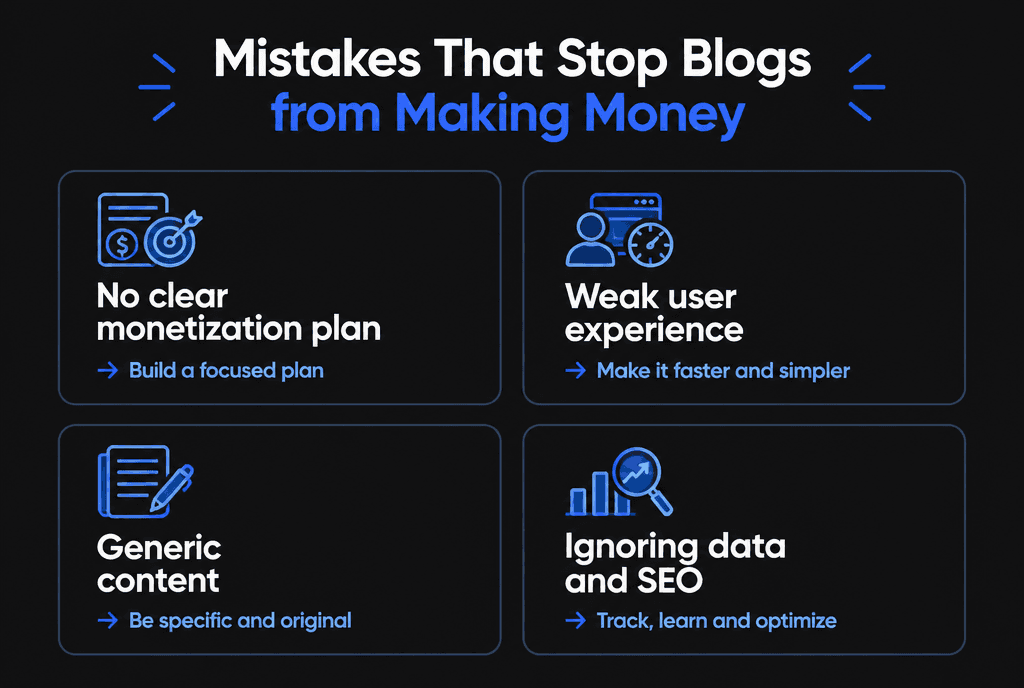
The common mistakes are having no monetization plan, weak user experience, generic content that repeats what ranks already, and ignoring data and SEO.
How should a revenue-generating blog be structured?
Organize content into topic clusters: a pillar page for each core topic, supporting posts that answer specific questions, and internal links from every post to the pillar and to a relevant money page.
Pillar: "Google Ads for small businesses"
Supporting posts: costs, keywords, landing pages, mistakes
Money page: the service, product or affiliate comparison
Use descriptive anchor text, following Google's link best practices.
What features does a monetized blog need?
Fast article templates, clear headings and tables of contents, author bios, email signup forms, contextual calls to action, related posts, structured data and an analytics setup that tracks revenue events.
Article structured data for headline, author and dates
In-content calls to action that match the post's topic
Email capture with a relevant lead magnet
Author pages that show real expertise

How do you keep a monetized blog fast?
Reserve space for ads and embeds, lazy-load below-the-fold media, compress images, limit third-party scripts and test Core Web Vitals on real article pages, not just the homepage.
Google's page experience guidance and Web Vitals targets apply to every template. Our site speed guide covers the technical fixes.
What content earns money from search?
Content that solves a specific problem with real experience earns the most: comparisons, how-to guides, cost breakdowns and "best for" posts. Generic content that repeats top results rarely ranks or converts.
Follow Google's guidance on helpful, people-first content, and disclose sponsorships and affiliate links as the FTC explains in Disclosures 101.
How do you measure blog revenue?
Track subscribers, leads, affiliate clicks and sales by article, and compare revenue per 1,000 visits across posts. Then update and expand the posts that earn, and prune or merge those that do not.
Set up Google Analytics recommended events for sign-ups, leads and purchases.
How do you build a blog that drives revenue?
Pick the model, map topic clusters, build fast templates with conversion points, publish consistently and review revenue by post every month.
Our web development team builds monetized blogs on WordPress and custom stacks, and our SEO team plans the content. See also conversion-focused web development.