
X Ads examples are useful only if you can copy the structure behind them. Below are five campaign playbooks we use with clients at Savoir Management on X (formerly Twitter). Each one explains the idea, how to set it up, who to target and which metric decides whether it is working. We describe the patterns rather than naming clients, so you can adapt them to your own offer.
Why do X Ads perform differently from other platforms?
X is built on real-time conversation, so ads that feel like part of the conversation outperform ads that interrupt it. People go to X to react to news, trends and opinions, which rewards fast, specific and native-looking creative.
That changes how you plan campaigns. On search, intent is stated in the query. On X, intent is implied by what people discuss and who they follow. X's campaign objectives let you optimize for reach, video views, engagement, traffic, app installs or conversions, and the right choice depends on which playbook you run.

Playbook 1: How do conversation-style text ads work?
Conversation ads look and read like a regular post from your brand: a strong opinion, a useful tip or a question, followed by a link. They earn clicks because they fit the feed instead of fighting it.
Set up: promoted post, website traffic objective, one image or none.
Copy: lead with a specific claim your audience cares about, such as a mistake they are making.
Targeting: keyword targeting on terms your buyers use in their own posts.
Judge it by: click-through rate and cost per landing page view.
Playbook 2: How does a carousel funnel lower acquisition cost?
A carousel funnel uses a multi-card ad to show several products or proof points, then remarkets to everyone who clicked with a single focused offer. It works well for e-commerce brands whose costs have risen on other social platforms.
Run a carousel with three to five products or benefits to a broad interest audience.
Build a custom audience of people who clicked or visited the site.
Remarket with one best-selling product and a time-bound offer.
Compare blended cost per purchase against your other channels.

Playbook 3: How do you use video and remarketing together on X?
Use short captioned videos to reach new people cheaply, then remarket to viewers who watched most of the video. Video viewers are already warm, so the follow-up ad converts at a lower cost.
Keep videos under 30 seconds and caption them, because many people scroll with sound off.
Show the product or result in the first two seconds.
Retarget people who watched at least half of the video with a direct offer.
Playbook 4: Can X Ads generate B2B leads?
Yes. Send traffic from keyword and follower look-alike audiences to a short landing page with a useful offer, such as a checklist, audit or demo. Lead quality depends far more on the landing page than on the ad.
Targeting: follower look-alikes of industry publications, competitors and analysts.
Offer: something worth an email address, delivered instantly.
Landing page: one headline, three bullets and a form with three fields. Our landing page guide covers the build.
Judge it by: cost per qualified lead after sales review, not raw form fills.
Playbook 5: How do you run timely, trend-based ads?
Trend ads tie your offer to a live event, holiday or news moment while people are discussing it. They work when creative and approvals are ready in advance, so you can launch within hours instead of days.
Build a calendar of predictable moments in your industry.
Prepare two or three ad variations for each, with copy that still makes sense if the moment shifts.
Avoid tragedies, politics you do not want tied to your brand and anything that could read as opportunistic.
What makes an X ad playbook repeatable?
A playbook becomes repeatable when it has a fixed objective, a defined audience, a test budget, a success metric and a rule for when to scale or stop. Write those down for every campaign before launch.
Track every campaign with the X Pixel and UTM-tagged links, and confirm results in Google Analytics. Platform-reported engagement is not revenue.
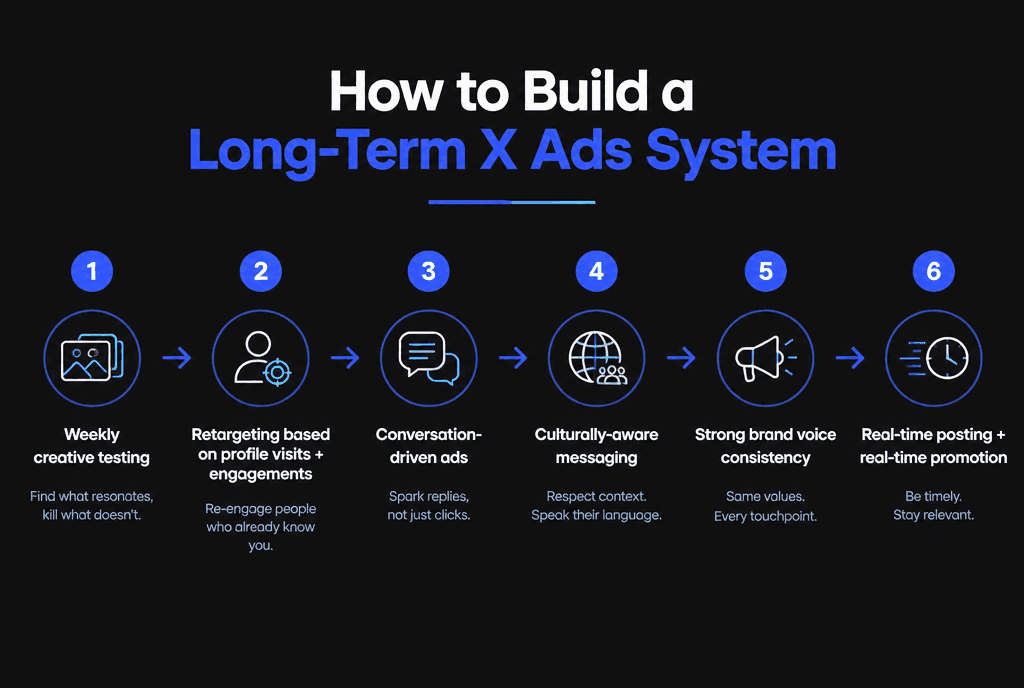
A long-term system usually includes:
Weekly creative testing
Remarketing to profile visitors, video viewers and site visitors
Conversation-driven ads tied to topics your buyers follow
A consistent brand voice across organic and paid posts
When a playbook proves itself, use our framework for scaling X Ads to grow it without spiking costs.
Who is on X, and is your audience there?
X reaches a smaller share of U.S. adults than YouTube or Facebook, but its users skew toward news, tech, finance, sports and politics. If your buyers live in those conversations, X can reach them at lower competition than larger platforms.
According to Pew Research Center's social media fact sheet, YouTube and Facebook are the most widely used platforms in the United States. In its 2025 survey, 33% of adults ages 18 to 29 and 25% of those 30 to 49 said they use X, compared with 95% and 92% for YouTube. Check your own audience data before committing budget, and compare X with TikTok and Meta for the same offer.
Need help picking the right channel mix? Talk to our digital marketing team.


