A YouTube ads funnel strategy fixes the most common reason YouTube ads lose money: asking strangers to buy in the first five seconds. Instead, you build three stages of campaigns that introduce, nurture and convert. This is the funnel structure we use at Savoir Management for service businesses and e-commerce brands, with the formats, audiences and metrics for each stage.
Why do most YouTube ads fail to make money?
Most YouTube ads fail because they skip the funnel. They pitch a cold audience, optimize for cheap views and never follow up with people who watched. Buyers need awareness and trust before they act.
YouTube's reach is huge. Pew Research Center's 2025 survey found that 95% of U.S. adults ages 18 to 29, 92% of those 30 to 49 and 85% of those 50 to 64 use YouTube. Reach is not the problem. Sequencing is.

What are the three stages of a YouTube ads funnel?
The three stages are awareness, consideration and conversion. Each has its own audience, ad format, message and success metric, and people move down the funnel based on how they engaged with earlier ads.
Awareness: introduce the problem and your brand to new audiences.
Consideration: show proof, education and differentiation to people who watched.
Conversion: make a direct offer to warm viewers and site visitors.
Stage 1: How do you build awareness with YouTube ads?
Use short skippable in-stream, Shorts and bumper ads to reach new audiences based on interests, custom segments and topics. Judge this stage by cost per engaged view and growth in viewers you can remarket to, not by sales.
Google's video ad formats include skippable and non-skippable in-stream ads, in-feed video ads, bumper ads and Shorts ads. For awareness:
Lead with the viewer's problem in the first five seconds.
Brand early, so even skippers remember you.
Keep it under 60 seconds.
Google's ABCDs of effective video ads (attention, branding, connection and direction) are a reliable creative checklist.
Stage 2: How do you nurture viewers who already watched?
Remarket to people who watched your awareness ads, visited your channel or subscribed, using testimonials, demos, case studies and objection-handling videos. This stage builds the trust that makes stage three convert.
Link your YouTube channel to Google Ads and build data segments of viewers, channel visitors and website visitors. Then serve:
Customer stories and before-and-after results
Short demos that answer the top three objections
"How it works" explainers
Stage 3: How do you convert warm audiences on YouTube?
Run conversion-optimized Video or Demand Gen campaigns to viewers and site visitors with a specific offer and a clear call to action. Measure cost per lead or purchase, and send clicks to a landing page built for that offer.
Demand Gen campaigns run across YouTube (including Shorts), Discover, Gmail, Maps and the Google Display Network and are designed to drive engagement and action. Pair them with Target CPA bidding once you have enough conversion data. Your offer should be concrete: a free consultation, a trial, a discount or a demo.

What audiences should each funnel stage target?
Target broad interest, custom and topic audiences at the top, your own viewers and site visitors in the middle, and engaged viewers, cart abandoners and past leads at the bottom. Exclude converted customers from earlier stages.
Top: custom segments built from search terms your buyers use, in-market audiences and relevant topics.
Middle: people who watched 50% or more of a stage 1 ad, channel visitors and subscribers.
Bottom: website visitors, people who viewed a pricing or product page and email lists.
How do you measure a YouTube ads funnel?
Measure each stage by its own job: engaged views and audience growth at the top, view rate and site visits in the middle, and conversions and cost per acquisition at the bottom. Set up conversion tracking before launch.
Install Google Ads conversion tracking on leads and purchases. Compare:
Cost per engaged view (stage 1)
View rate and click-through rate (stage 2)
Cost per lead or sale and return on ad spend (stage 3)
What mistakes destroy a YouTube funnel?
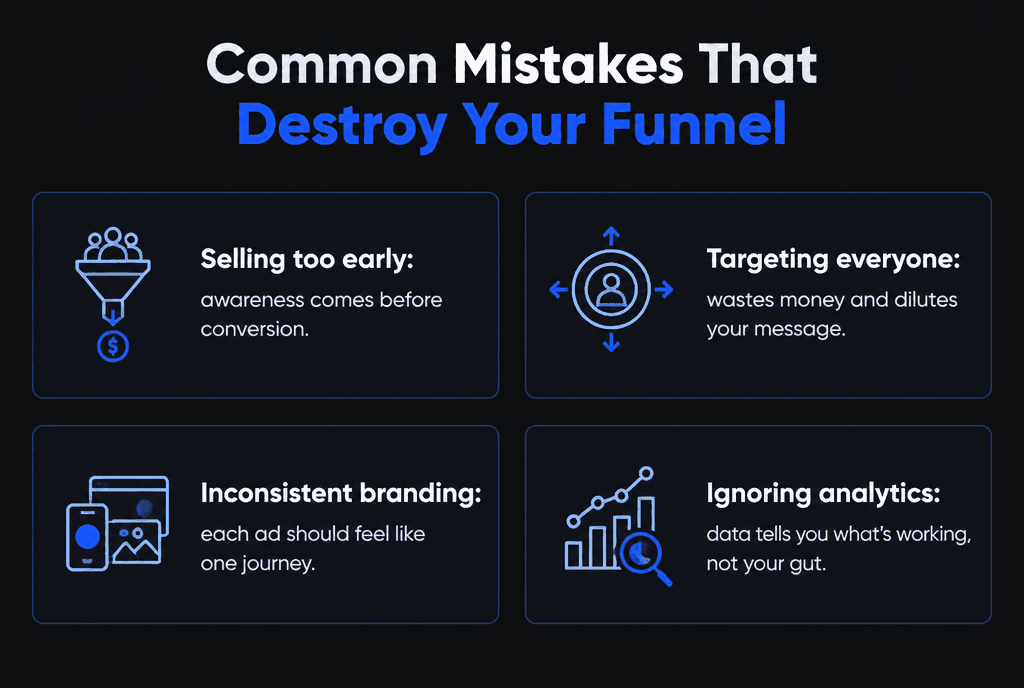
Selling too early, targeting everyone, inconsistent branding between stages and ignoring analytics are the four mistakes we fix most often.
How do you scale a YouTube funnel that works?
Scale the stage that limits results. If stage 3 converts well but runs out of audience, add budget to stage 1. If stage 1 fills audiences that do not convert, fix stage 2 creative before spending more.
Increase budgets 20 to 30% at a time and refresh creative every few weeks. For creative ideas, see how to create YouTube ads that convert, and if you are new to the platform, start with our YouTube ads for beginners blueprint. The landing page matters as much as the ad, so read our guide to high-converting landing pages, or let our digital marketing team build the funnel.